Calculus is the study of changing variables.
Important Symbols
- The differential symbol. Means a “little bit of”. So, means a “little bit of “. Could be infinitely small.
- The integral symbol. Long s means “sum of”. So, means the “sum of the little bits of “
On smallness
At a certain point, small values become negligible. Consider a square where represents the length of one side. The area of the square, therefore, is . Now, consider that you were to add to , meaning increasing each side of the square by . How much would the area grow by? This can be represented by the following diagram:
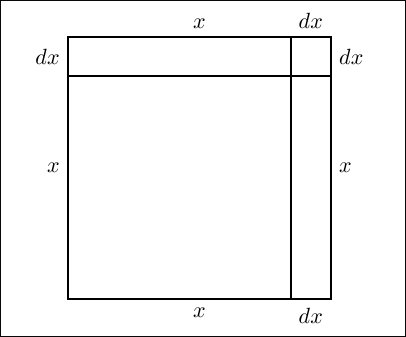
By taking the area with , we get , which can be expanded to: . Now, note that the term is an order of magnitude smaller than even . Because it is so small, we are free to ignore it and consider it to be effectively zero. This is even more true for smaller and smaller values of .
On relative growings
Calculus is largely about how different values can grow and change in relation to one another. Consider the following example: Let represent the horizontal distance, from a wall, of the bottom end of a ladder . Let be the distance at which the top of the ladder rests on the wall. The question arises: If we were to pull the ladder further away from the wall, thereby increasing , how much would change? The following figure represents the situation:
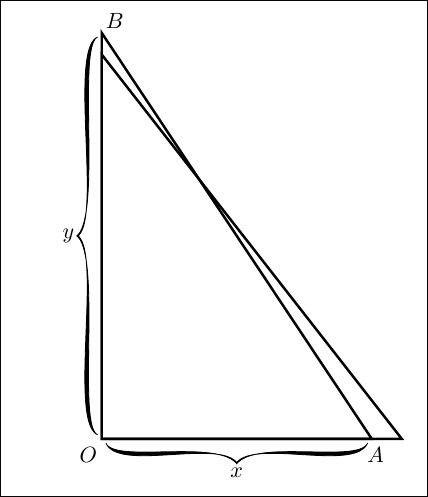
We will solve this with example data first. Suppose the ladder was so long such that where is from the wall, meets the wall above. If changes by , then, how much does change by?
The above example also delivers a key intuition: in order for to make any sense, y and x must have some relation. In this example, the relation was the following:
So, because there is a relation, a change in x affecting y by some amount makes sense.
Simplest Cases
Power Rule
Power rule is defined as the following:
This works for any , and this can be viewed intuitively from the following:
Sources
Much of this note comes from one source: Calculus Made Easy by Silvanus P. Thompson This is an attempt to intuitively explain fundamental concepts of calculus rather than going through rigorous math. The other source considered is: 3Blue1Brown’s Essence of Calculus Series